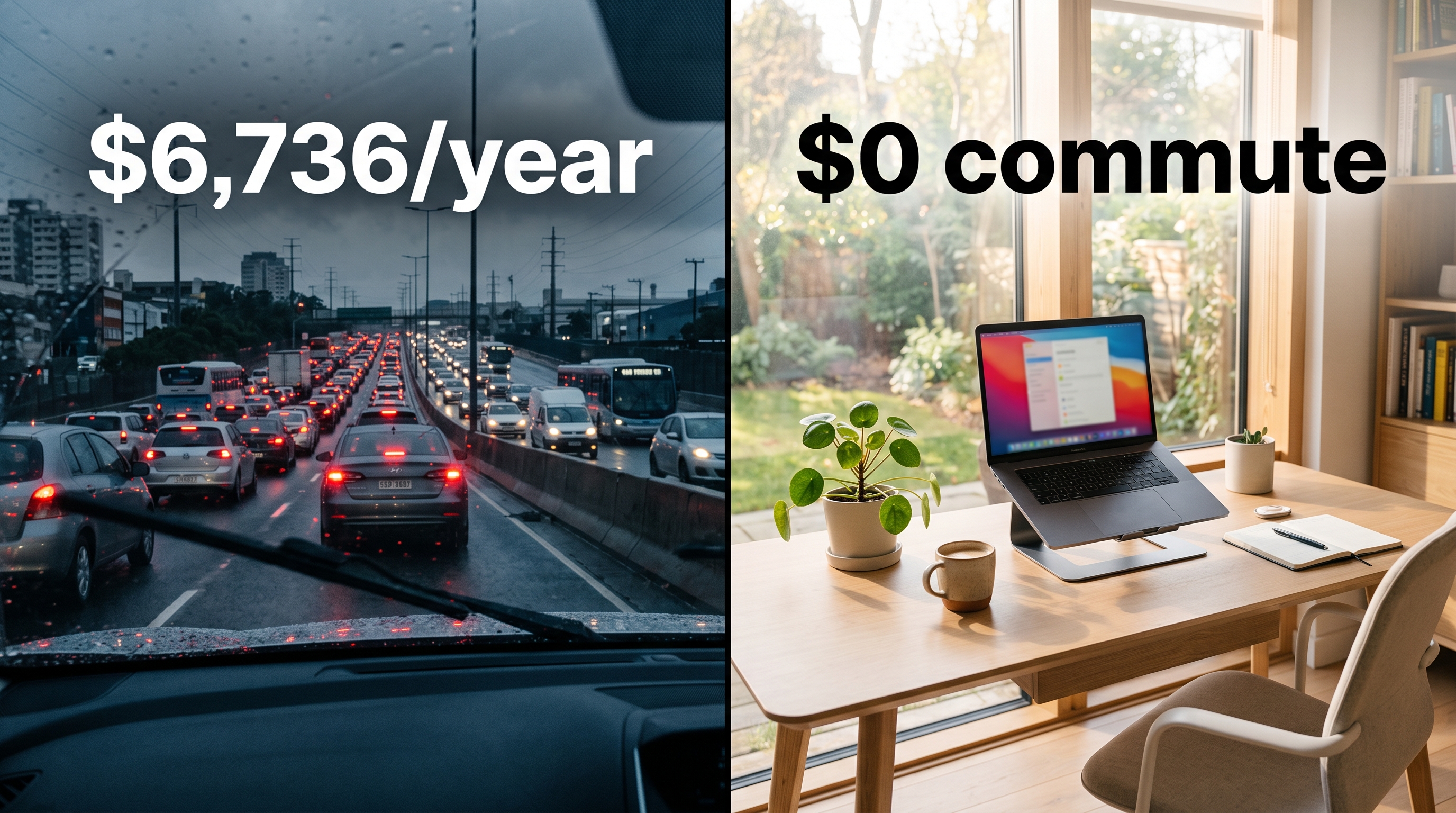
Most remote-work debates are about culture. This one is about money. If you run a U.S. business and you're deciding whether a role needs a desk, here are the numbers on both sides of the paycheck, and how to decide role by role.
What one office desk really costs an employer
Rent is the smallest surprise. At $40 per square foot and a typical 150 square feet per person, space alone runs about $6,000 per employee per year. Add utilities, furniture, internet, cleaning and supplies, and traditional leases typically land between $500 and $1,200 per employee per month.
For a 10-person team, that's $60,000 to $144,000 a year before anyone starts working.
Global Workplace Analytics estimates that a typical U.S. employer saves about $11,000 a year for each employee who works remotely half the time, mostly through higher productivity, lower real estate costs, less absenteeism and lower turnover.
What employees pay just to show up
The cost doesn't stop at the company. An August 2026 survey of 1,000 full-time U.S. office workers across 36 metro areas found they spend $6,736 a year on going to the office. Food and coffee bought on office days alone add up to $2,598.
Time is the bigger loss:
184 hours a year commuting, about 23 working days
137 more hours getting ready on office days, about 17 working days
In total, roughly 40 working days a year spent getting to work
And it's getting more expensive: 53.2% of workers say their office costs rose in the last 12 months.
Does productivity drop when people work from home?
The strongest study we have says no, at least for well-run hybrid work. Stanford economist Nick Bloom ran a randomized controlled trial with 1,612 employees, published in Nature in 2024. Hybrid work cut quit rates by one-third with no drop in performance reviews over two years. Managers who expected productivity to fall ended the study rating it slightly positive.
That turnover number matters. The company estimated each quit cost about $20,000 in recruiting and training, so cutting attrition by a third saved millions.
Flexibility works like compensation
Workers value flexibility in dollars. Owl Labs' 2026 data shows 47% would accept a 10% pay cut to keep flexible hours, and 39% would turn down a job that requires full-time office work.
That makes remote work one of the few benefits that costs the employer less while being worth more to the employee.
Where remote work falls short
Remote isn't the answer for every role. Bloom's research shows fully remote setups struggle when they're poorly managed, and onboarding, mentoring and hands-on work still benefit from time in person.
Employers also have more leverage than they did. One 2026 survey found only 7% of employees would quit outright over a return-to-office mandate, down from 51% in January 2025. But being able to require the office doesn't mean every role should pay for one.
How to decide, role by role
Instead of picking a side, sort your roles into two groups:
On-site roles: hands-on work, in-person client service, or heavy daily collaboration. Keep these in the office. The desk is worth it.
Remote-capable roles: executive assistance, customer support, sales development, bookkeeping and accounting, dispatch, marketing and software development. These usually don't need a desk, and often don't need to be in your city.
Once a role is remote, you can hire beyond your local market. Many U.S. small businesses now hire pre-vetted professionals in Latin America who work U.S. hours, speak fluent English, and cost often 50–70% less than a comparable U.S. salary, with no office overhead.
What remote roles cost when you hire in Latin America
Typical full-time monthly salaries in 2026:
Role | Latin America | U.S. (base salary) |
|---|---|---|
Virtual Assistant | $1,000–$2,000 | $3,500–$5,000 |
Executive Assistant | $1,500–$2,800 | $4,600–$8,800 |
Customer Support | $1,000–$2,000 | $3,500–$5,000 |
SDR / Sales Agent | $1,500–$2,800 + commission | $4,000–$7,500 |
Bookkeeper | $1,200–$2,500 | $4,500–$6,500 |
See all 11 roles in our full guide: How Much Does It Cost to Hire in Latin America?
The bottom line
Employers spend $6,000 to $14,000+ per desk each year, plus turnover they could cut by a third.
Employees spend about $6,700 and 40 working days a year just getting to work.
Productivity doesn't drop with well-run hybrid work, according to the best study available.
Before your next hire, ask: does this role need a desk, or does it need the right person?
Frequently asked questions
How much does office space cost per employee in 2026?
Space alone costs about $6,000 per employee per year at $40 per square foot. Including utilities, furniture, internet and maintenance, most U.S. employers spend $6,000 to $14,000+ per desk annually.
How much do employees spend to commute to the office?
A 2026 survey of U.S. office workers found they spend about $6,736 a year on going to the office, including commuting, food and coffee, plus roughly 40 working days in commute and preparation time.
Does remote work reduce productivity?
A randomized study of 1,612 employees published in Nature found hybrid work had no effect on performance reviews over two years and cut quit rates by one-third.
Which roles work best remotely?
Roles like executive assistance, customer support, sales development, bookkeeping, dispatch, marketing and software development usually work well remotely. Hands-on and in-person client roles are better kept on-site.
How much can a business save hiring remote talent in Latin America?
Hiring in Latin America is often 50–70% less than a comparable U.S. salary, with no office costs. Exact savings depend on the role, seniority and English level. See costs by role.
This article started a great conversation on LinkedIn. Join the discussion here.
Want to know which of your roles could go remote, and what you'd save? Book a free 30-min call and we'll run the numbers together.
Sources: Global Workplace Analytics; Bloom, Han & Liang, Nature (2024); Owl Labs State of Hybrid Work (2026); resume.io / Pollfish survey (Aug 2026); MyPerfectResume (2026); OfficeSpace Software and Venture X 2026 cost benchmarks; UpHiire 2026 salary ranges.