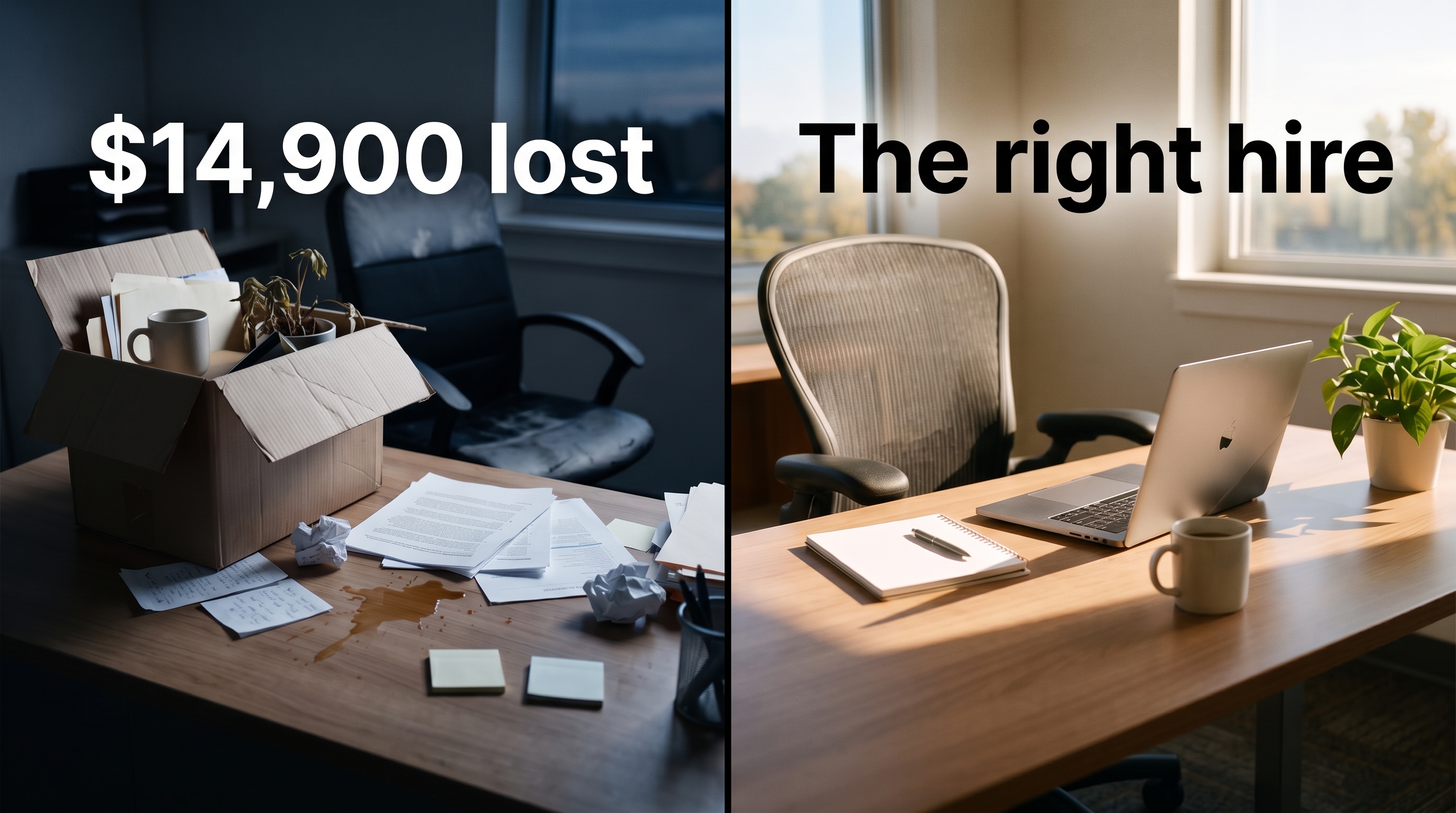
If you run a small or growing business, a bad hire is one of the most expensive mistakes you can make, and one of the hardest to see on a budget. Here are the 2026 numbers, what a bad hire costs at different salary levels, and the process I've used in 10 years of staffing to avoid them.
The short answer
A bad hire costs at least 30% of the employee's first-year earnings, according to the U.S. Department of Labor's widely used estimate. In a CareerBuilder survey of 2,257 hiring managers, 74% of employers said they had hired the wrong person, with an average reported cost of $14,900.
Once you add hiring again, management time and lost productivity, a mid-level bad hire often costs $25,000 to $40,000 for a small business.
What a bad hire costs by salary level
Estimates for a hire that takes six months to identify and replace:
Annual salary | Lost value (30%) | Hiring again | Manager time | Estimated total |
|---|---|---|---|---|
$40,000 | $12,000 | $4,700 | $7,650 | ~$24,350 |
$50,000 | $15,000 | $4,700 | $7,650 | ~$27,350 |
$70,000 | $21,000 | $4,700 | $7,650 | ~$33,350 |
$100,000 | $30,000 | $4,700 | $7,650 | ~$42,350 |
Assumptions: lost value uses the Department of Labor's 30% estimate; hiring again uses SHRM's average cost per hire of about $4,700; manager time assumes a $90,000 manager spending 17% of their time on the problem for six months. Totals don't include the empty seat, team turnover or customer impact, so real costs are often higher.
The hidden costs most owners miss
The salary is the visible part. These are the costs that don't show up as a single line item:
Recruiting twice. Job posts, interviews and onboarding time are spent again.
Management time. Robert Half research finds managers spend about 17% of their time handling underperformers.
The empty seat. Work stalls or gets pushed onto other people while you replace the role.
Team morale. Strong performers notice when a problem goes unaddressed, and some leave.
Customers. Missed follow-ups, errors and slow responses can cost you clients you never hear from again.
Why bad hires happen
Most bad hires have the skills for the job. Leadership IQ found that nearly half of new hires fail within 18 months, mostly because of attitude and fit rather than missing skills.
That explains why a résumé and one friendly interview miss so many of them. Common causes:
Hiring in a rush because the work is piling up
A vague role, so nobody knows what "good" looks like
Interviews that test charm, not work
Skipping reference checks
No onboarding plan, leaving a good person set up to fail
Warning signs in the first 30 days
You can usually spot trouble early if you know what to watch:
Deadlines slip without warning or explanation
The same questions get asked repeatedly after being answered
Feedback is met with defensiveness instead of adjustments
Communication goes quiet when problems appear
Teammates start quietly covering their work
One sign alone isn't a verdict. Two or three together deserve a direct conversation, early.
How to avoid a bad hire: a 6-step process
Define results first. Write what success looks like at 30, 60 and 90 days before posting the role.
Test real work. Give finalists a short, paid task based on the actual job.
Interview for attitude. Ask how they handled a mistake, a difficult customer or unclear instructions, and listen for ownership.
Check references properly. Ask: "Would you hire this person again?" Hesitation tells you a lot.
Plan onboarding. A clear first 90 days turns many "bad hires" into good ones. See our guide to onboarding a remote employee.
Share the risk. If you use a staffing partner, ask what happens if the hire doesn't work out. At UpHiire, every placement includes a 30-day replacement guarantee: if the hire isn't the right fit, we find you a replacement at no extra cost.
Hiring remotely? Add these checks
Remote hiring has a few extra risks, and a few extra ways to manage them:
Test communication live. A video call shows real English level and clarity better than a résumé.
Confirm working hours. Make sure the candidate can work your time zone consistently.
Run the work test remotely. It shows how they handle tools, deadlines and written updates.
Set up check-ins. Short daily or weekly updates catch problems in days, not months.
Hiring pre-vetted professionals in Latin America is one way to reduce both risk and cost. Candidates work U.S. hours, and salaries are often 50–70% less than a comparable U.S. salary. See costs by role.
A bad hire hurts the person too
Nobody wants to be the wrong hire. Landing in a role without clear expectations or support is stressful and can set a career back. A better hiring process isn't just cheaper for companies. It's fairer to the people being hired.
Frequently asked questions
How much does a bad hire cost?
At least 30% of the employee's first-year earnings, according to the U.S. Department of Labor's estimate. For a $50,000 role, total costs including rehiring and management time often reach around $27,000.
What percentage of employers have made a bad hire?
In a CareerBuilder survey of 2,257 hiring managers, 74% of employers said they had hired the wrong person for a position.
Why do most new hires fail?
Research from Leadership IQ found that most new hires who fail do so because of attitude and fit, not a lack of technical skills.
How can a small business avoid a bad hire?
Define clear results for the role, test candidates with real work, interview for attitude, check references, plan the first 90 days, and work with a staffing partner that offers a replacement guarantee. UpHiire includes a 30-day replacement guarantee on every placement.
How long does it take to spot a bad hire?
Warning signs often appear in the first 30 days, such as missed deadlines, repeated questions and defensiveness to feedback. Acting early limits the cost.
This topic sparked a conversation on LinkedIn. Join the discussion here.
Hiring soon? Book a free 30-min call and we'll help you build a hiring process that gets it right the first time.
Sources: U.S. Department of Labor estimate; CareerBuilder survey of 2,257 hiring managers (2017); SHRM cost-per-hire benchmarks; Robert Half; Leadership IQ.